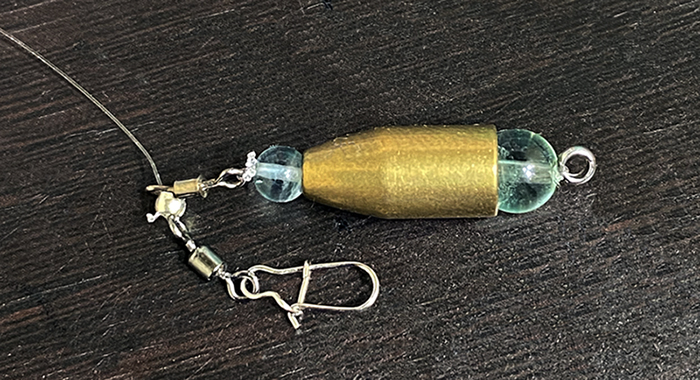
My project here was to improve the separate sinker I use at a strong-current ajing spot I often visit.
At this location, a split rig is practically unavoidable. A certain amount of sinker weight is necessary, and I had assumed that a slight loss of sensitivity was simply part of the compromise.
Then I saw 34’s S-Carry. I felt that its much lower contact resistance, compared with an M-Caro, would improve sensitivity. I thought I could apply that approach to my split rig. After working on the idea and experimenting, this is the version I arrived at.
The original title compares its sensitivity to fishing a 0.1 g jighead alone, expressing the author’s personal impression.
Weight and retrieve in the current
The photograph shows the 4 g model, built with a 3.5 g brass bullet sinker.
At this strong-current location, I mainly use 3 g when allowing the rig to drift naturally. With heavier weights, I make small adjustments to the retrieve to suit the flow and bring the rig into the depth I want to fish.
The more active the fish, the heavier I go and the faster I retrieve. The hook is a Split Shotter.
The reason for making it myself is simple: the thing I want is not sold. For all the development in the fishing industry, I find it curious that this style of rig is missing.
The lengths I settled on
I am currently using a brass bullet sinker, with a bead below and a swivel above, arranged so that it can move along about 28 cm of line.
My experiments showed that tangles could occur unless the leader attached to the hook was shorter than 25 cm. I therefore set that leader at about 22–24 cm.
- Swivel and clip-snap section: approximately 2.7 cm long, with a combined weight of 0.09 g.
- Overall length: approximately 53–54 cm.
If the overall rig is too long, lifting it out with a short rod becomes awkward. I think a length around this should remain manageable.
Read this article on Passionable Fishing (日本語) ↗