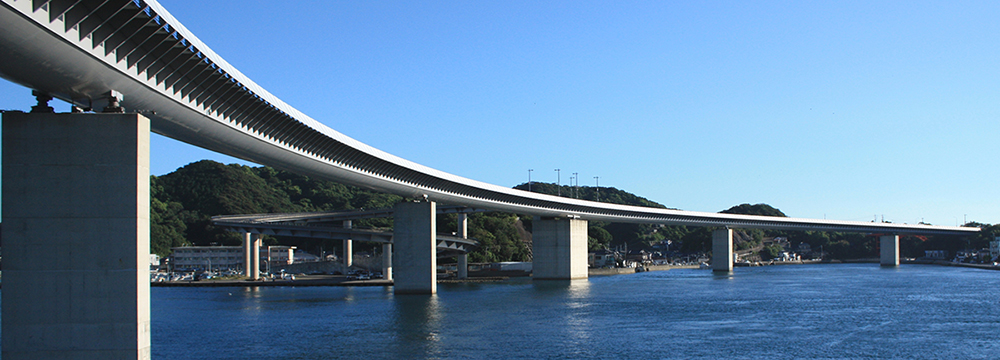
An account from April 2020. The descriptions of fishing spots and parking reflect the original visit notes.
Beneath Ushibuka’s Haiya Bridge: a very well-known fishing spot. I have not been there all that often—perhaps ten trips—but I will write what I can from that experience. This may not be much of a guide.
The current and the weight
I mainly fish the rising tide, when the current runs to the right. Yet this is a curious place: the direction can change partway through the rising tide. Sometimes the water swells up, and then the change comes.
Even on the shallower side, I use a homemade M-Caro-style carrier of around 11 g. My wife fishes quite normally with a TICT M-Caro of about 7 g.
Long casts are essential on the deeper side. Homemade carriers of 11–13 g, or heavier ones up to around 20 g, seem to be fairly usual there. Let the rig reach the bottom, and you have to be prepared for snags. That seems to be the established way of fishing it.
Alternatively, a TICT 11 g M-Caro can be used to fish down to mid-water. There are certainly big aji near the bottom, though.
Personally, I have a fear of snagging. Rather than aiming for the bottom there, I prefer to shift a little and cast from somewhere else.
From the first corner to the bridge pier
My position is at the first corner beyond the harbour. With the current running right—in other words, on the rising tide—I first cast towards the slope rising out of the deeper water.
The rig reaches the bottom. A couple of light lifts of the rod, and it begins drifting further right. Then come the little taps: tap, tap. There is nothing left to do but hook the fish, so I strike quickly and wind in. The water to the right of this position is shallow, and the fish comes up to the surface quite soon.
It is a little dark here, which makes the fish difficult to see.
Move a little further right and it becomes brighter. This puts me in front of a bridge pier. Casting towards the left-hand base of the pier finds a kasago hideout; to its right are schools of aji.
Aji are quick, of course, and can turn up anywhere. But the left-hand base feels like an entire street of kasago houses. Some of the fish are enormous. I release any I catch: I describe them here as an “endangered species”. Five in a row, sometimes—and I begin to wonder what I came to fish for.
Once, I felt an extraordinarily powerful pull. Strong enough to make me think of a seabass, although I have no idea what it was. If it was an aji, it was a giant—but surely there should not be one that size here.
In any case, the rod was bent as far as it could go. All I could do was hold on. Then the fish forced its way still further down.
Wait—down?
And there it stayed, snagged. With that much power driving downwards, even an extremely stiff ajing rod was no answer. There was nothing for it: I pulled hard until the line parted at the knot.
Goodbye, fish.
Time to move.
Long casts into the shadow
A little further right takes me past the right-hand side of the pier. Keep going a long way and there is another pier, but I do not go that far.
There is enough light around this stretch to make fishing comfortable. Squid turn up too, so there is plenty to enjoy.
For aji, long casts are good. There is a shaded area on the far side beneath the bridge, and reaching it improves my catches. It is quite a distance, but I use my Blue Current 82F here, so I can get the rig that far.
That model is finishing production in 2020. When we visited the Yamaga Blanks factory the other day, the discontinued models were piled up. Well, laid out horizontally, rather than piled up. They were there for comparison.
My wife picked up a new rod and gave it a few swings. Her very first words were: “You have changed the concept, haven’t you?”
“Yes, we have,” said the person from Yamaga.
My wife. As perceptive as ever.
Now, where was I?
In that shaded area, I often get a fish within a few seconds of the rig reaching the bottom. After the first or second lift of the rod, there it is: tug-tug-tug.
In this area, it feels as though fish can be caught in either direction of current, when they are feeding. It is straightforward, enjoyable ajing beneath Haiya Bridge.
A narrow place to stand
Care is needed when standing on top here. It is extremely narrow.
I park in the open area a good way further to the right, because there are homes close to the fishing spot.
At the time of writing, I am not coming here for ajing very often. The other place I fish in strong current is constantly changing, and I find it far too interesting.
Translation note: “endangered species” is the wording used for kasago in the Japanese account; the source does not identify a formal conservation classification.
Related: An angler’s thoughts on Amakusa’s bridges, and my later notes on sinkers for strong current.
Read this article on Passionable Fishing (日本語) ↗