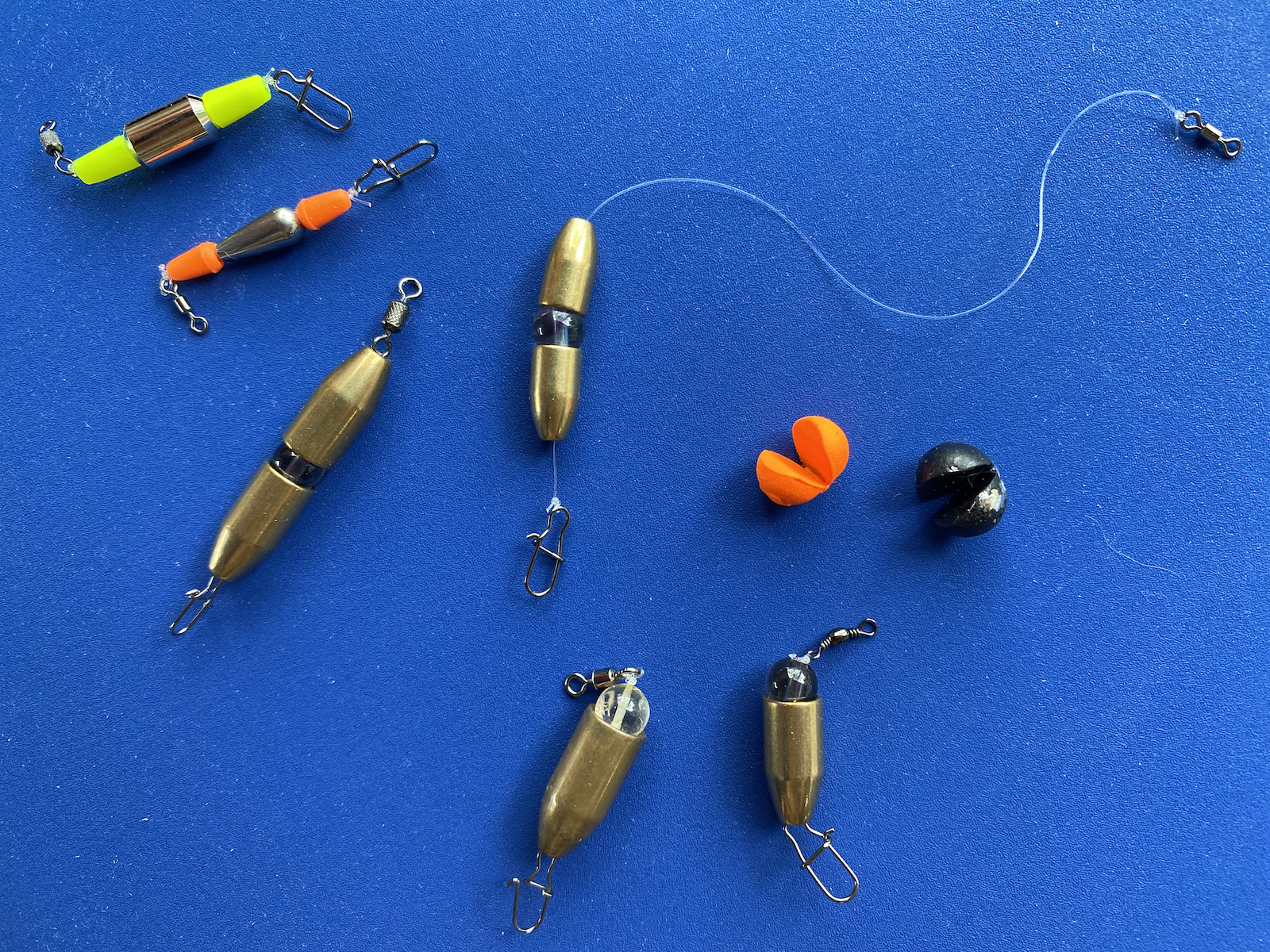
These are my personal impressions. After trying all sorts of types, the sinkers that remained in use were:
- Gekkabijin TG Ajing Sinker
- AJ Split Sinker
- Brass bullet sinkers for Carolina-style rigs
- Tungsten Carolina Stick sinkers for Carolina-style rigs
How they feel in use
They each feel different.
- Gekkabijin tungsten: works as expected.
- AJ Split Sinker: quite usable.
- JK tungsten, for a Carolina-style rig: I use it because I like the through-line concept, provided I overlook the product’s level of finish.
- Brass sinker, for a Carolina-style rig: thinking about water flow, I fit a crystal bead into the recessed end. This is fairly standard for me, although it is not perfect.
- Split shot: very good when used with a 0.4 g jighead. I do not use it with a bare hook alone.
Two very different kinds of current
The strong-current spot I usually visit is different from Ushibuka. The sinkers that work at one place can be completely different from those that work at the other.
At Ushibuka, I use commercial M-Caro sinkers and homemade Carolina-style rigs. Up to 11 g, I use the commercial M-Caro. If I need something heavier for a very long cast, I use a homemade one of around 13 g. I have made them up to 20 g.
I enjoy thinking about sinkers for my usual strong-current spot because there is still so much room to experiment.
People say that a split rig reduces sensitivity, but it is the standard choice there, for a reason.
The current simply sweeps an M-Caro away. Unless the fish are higher in the water, I cannot make it work.
As for fishing a jighead alone, the flow is usually faster than it can handle. I can only fish that way around slack water, or around nagashio—the weak-tide period with little tidal movement.
That leaves the split rig. In such strong current, I do not feel its loss of sensitivity is a very large problem. Naturally, though, more sensitivity is always welcome.
Hold the depth, move very little
When I hold the rig at a consistent depth, I would expect a through-line sinker to have a slight advantage, because the rod tip can feel the bite directly.
In practice, though, that arrangement limits me to holding the rig in place. I tested several ways of fishing it, and that was the only one that worked well.
I also tried adding a tube to make it more like an M-Caro, but the current often made it difficult to keep the balance right.
At this spot, however, I really can catch fish by holding the lure in what I call the “depth tunnel”—the band of water where the aji are holding.
The movement needed to tempt them is tiny: just a little twitch, twitch… about 1 cm. That is enough. Though I suppose 2 cm would be all right too. Ha!
The ones that switch on the turbo
I suspect the aji in that depth tunnel hold almost the same position, waiting with their mouths open for food to drift towards them.
That last bit is a joke. I imagine they open their mouths when the food arrives.
Holding position in that current means they are already swimming fast. Accelerating beyond that would call for a turbocharger—and a turbo comes with a little lag, doesn’t it? That is how I picture it.
Yet sometimes, when I start to retrieve the rig to bring it back in, an aji switches on its turbo and comes after it.
That is a wonderful moment.
Enthusiastic individuals like that are always very welcome. Please, do keep coming!
A later experiment: my homemade carrier and its sliding-sinker arrangement.
Read this article on Passionable Fishing (日本語) ↗