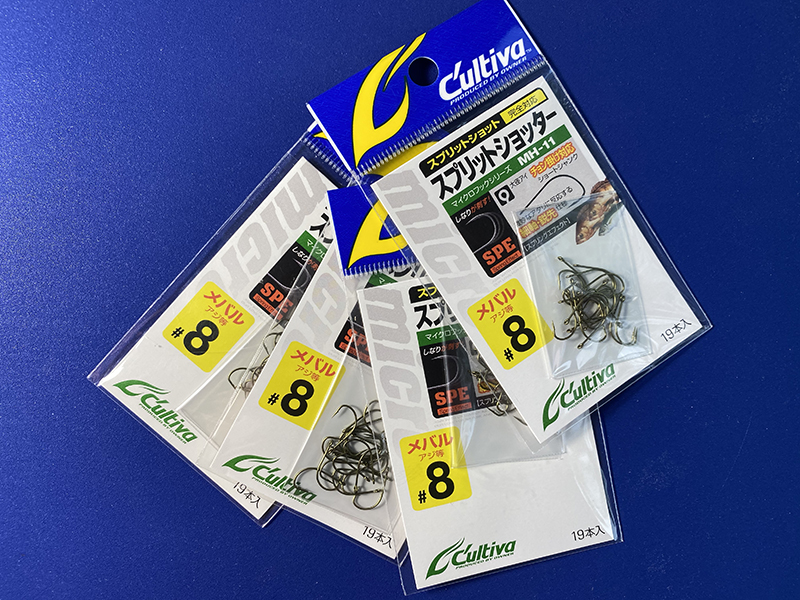
First published on 2 April 2020 and last updated on 1 May 2020. The jighead weights discussed below are the author’s reported measurements from that period. They have not been independently rechecked for this translation and do not establish the condition of current products.
This is the hook I use for ajing. As I have mentioned in other articles, fish take it into their mouths very quickly, and I lose few fish after hooking them.
When I hold the rig in flowing water, the aji take it without moving off. It also suits a steady retrieve.
On the fall, however, the hook and lure tend to rise out to the side, at right angles to the sinker’s path. It may therefore need more control than a jighead-only rig.
Almost all my ajing is in strong current, so I use Split Shotter hooks rather than jighead-only rigs. My wife uses both. Sometimes she fishes a separate split-rig sinker with a 0.4 g jighead.
Headshakes and jighead weights
I think one reason aji come off when they shake their heads is that the weight of a jighead acts like a pendulum, producing centrifugal force. Some jigheads seem more prone to this than others. I feel that the positions of the eye and the centre of gravity may also play a part.
I once compared how often fish came off jigheads from several well-known manufacturers, in weights from 0.4 g to 0.6 g. This was in a situation where I knew the feeding depth clearly and could get a bite whenever I drifted the rig through it.
The weights I compared were TICT: 0.4 g; 34: 0.5 g; Range Cross: 0.6 g.
The red-eyed TICT jigheads came with either a fine-wire or a heavier-wire hook. In my checks, the fine-wire 0.4 g version weighed what it should. But the heavier-wire version labelled 0.4 g weighed 0.8 g, wherever I bought it.
I wonder whether that is still the case. In a check last month, I again found the same 0.8 g item packaged as 0.4 g. If TICT knows about this, I think those products ought to be recalled.
Personally, I regret buying them in quantity. I am not using jighead-only rigs now, so it is not an immediate problem, but it seems a waste to leave that stock unused. I have kept them in case another situation comes along where they would be useful—as 0.8 g jigheads.
There are various frustrations, but I swallow a little of my annoyance and put up with them. Ajing is enjoyable, after all.
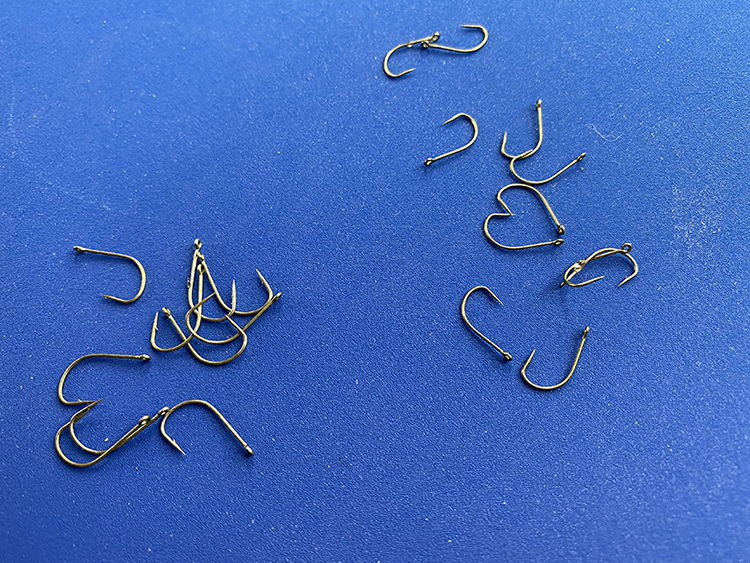
Are the gaps between hook sizes too large?
I do have a personal frustration with the Split Shotter hooks I am using for ajing. First, the sizes: #6 is larger; #8 is smaller.
Why is there no #7 in between?
I think the gap between those two sizes is too large. This is a question that really, truly, bothers me quite a lot. Fishing tackle often leaves me wondering about size choices like this. It does not quite reach the spot that needs scratching.
Then there is the shape. If the hook were just a little longer, it would be easier to remove. Only a little.
I would also like the #8 to use slightly thicker wire. After catching an aji of around 30 cm, I find that the hook bends too easily while I am removing it. It feels a little too weak.
And yet, in terms of size, it is just right for slim soft lures.
So there we are. This time my complaint about hook sizing is: “The gaps are too large!”
Or am I going too far?
Hmm. I wonder.
The explanation of headshake losses is the author’s hypothesis. The recall comment is the author’s conditional opinion in the historical account. Related: a rod-and-hook combination that seemed to hook fish by itself, and using a size 8 Split Shotter with Momoaji.
Read this article on Passionable Fishing (日本語) ↗