This is about fishing in strong current, of course.
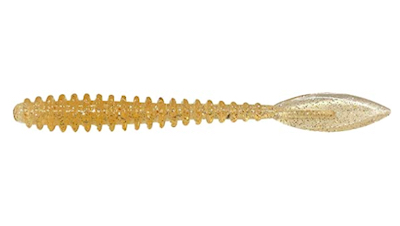
Take a fairly thick soft lure: the 2.5-inch Brilliant. As an aji sucks it in, I can feel the lure shaking in tiny movements on its way into the fish’s mouth. In other words, it seems a little difficult to eat.
Then again, perhaps the fish looks as though it is enjoying a delicious mouthful. It is hard to say.
By comparison, slimmer lures that move smoothly, such as Aji Caro Swamp and Fisit Nude, swim well and slip neatly into an aji’s mouth. Aji Adder Pro also swims well, so I use it often.
When I choose a bigger lure
Whether a slim or a thick lure gets more bites depends on the moment.
When the fish have become a little wary, a slimmer lure seems to arouse less suspicion and gets more bites. When they are keen to feed, a thicker lure gets hit sooner, and the fish tend to be bigger too.
If I am aiming for aji over 25 cm and they are feeding well, a large, bulky soft lure is the obvious choice for me. I also make the sinker a little heavier.
The rig drops through the layer of tiny aji. The large lure is falling too quickly for those little fish to take it properly, so it reaches the bigger aji below.
There, I make a small drawing movement with the rod, bringing the lure towards a fish’s mouth… and a big aji takes it as though it has been waiting all along.
When small aji are present but I want larger ones—as I usually do—I find it helpful to make a clear distinction through lure size and the speed of the fall.
Whatever you do, do not strike at the little taps as the rig passes through the small-fish layer.
So, in the end, it comes down to how the aji are behaving at the time.
Which way is up?
Even in a large size, Aji Adder Pro is relatively easy for the fish to suck in. Its tail is straight, but the body has distinct vertical and horizontal orientations.
Brilliant, by contrast, has a round body and a fin-like tail. I rig it so that the tail can move from side to side.
In my setup, though, there is no jighead weight at the hook to establish an up and a down. I suspect the lure turns in all sorts of directions underwater.
That makes me wonder about the usefulness of the fin-shaped tail. Still, it catches fish.
Perhaps a predator does not insist on only eating fish that swim perfectly straight. A fish lying on its side might look weak and easy to eat. That seems possible too.
I suppose each fish on the eating side is free to decide for itself. There are probably no rules of etiquette down there.
Hmm… freedom is a wonderful thing.
Related: using two soft lures to catch shaku aji on the fall.
Read this article on Passionable Fishing (日本語) ↗