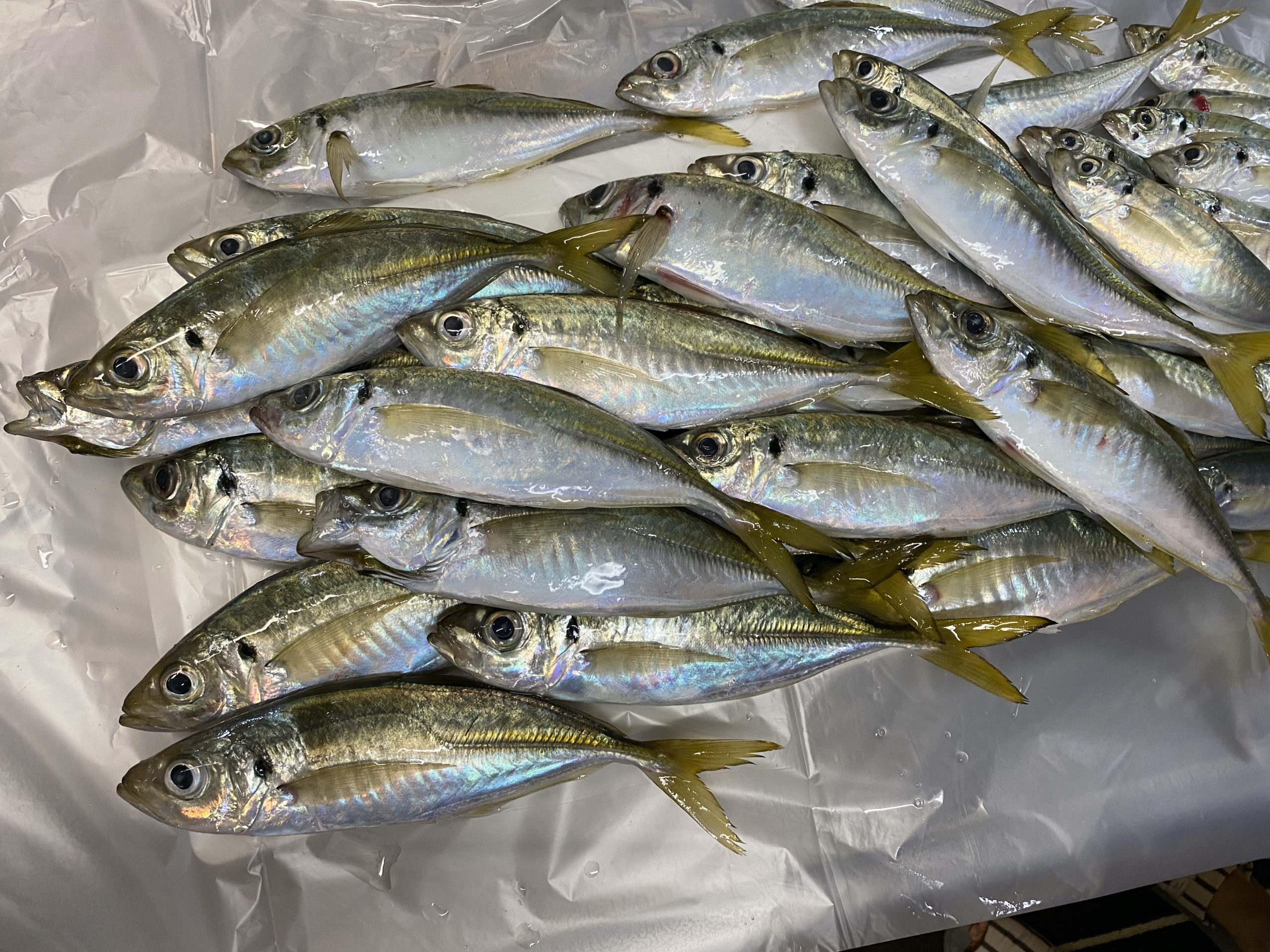
For the first time in a while, we enjoyed about an hour of almost constant bites.
The two of us caught more than forty fish of mixed sizes, including nineteen aji measuring 23–26 cm.
It was the first day of the spring-tide period. We began fishing an hour and a half before dawn.
Long rods and a particular rig
We needed long casts, so we used long rods.
- My rod: a Daiwa chinning rod—a rod for black sea bream—listed in my notes as 7.9 ft.
- My wife’s rod: BlueCurrent 82F.
- Line: Armored F+ Pro, Japanese PE size #0.3.
- Leader: Grandmax, Japanese size #1.2.
Perhaps the fish here were exceptionally wary. I tried various rigs, and most produced hardly any bites.
Only my own rig worked extremely well.
A jighead alone could not reach the fish in the first place. A jighead with a split sinker produced only about a tenth as many bites. A “?” with a split sinker was similarly quiet.
But “? + ○○○○○” brought a flood of bites.
The question mark and circles are left as written in the Japanese article; those rig components are not identified there.
Fish that knew the rocks
Occasionally, something that seemed to be a chinu—a black sea bream—would take the lure.
Once brought close, it would dive between the submerged rocks and break the line. It happened twice to me and once to my wife.
They almost seemed accustomed to doing it.
Tuning the rod for my approach
I was tuning an older 34 HSR-610, a rod for very large aji, to suit this way of fishing.
I wanted a gentler curve from tip to belly. To my eye, 34’s curve was too strongly shaped like a reversed Japanese hiragana “し”.
I was keeping my other HSR-610, the Version 2, largely as it was.
Personally, I liked the way Gamakatsu’s Yoihime rods bent.
Lately, I even found the Yoihime Hana 69FL easy to fish with, despite its flexibility extending well into the belly and, to my mind, slightly reducing sensitivity.
A rod with extreme sensitivity concentrated only in the very tip felt so clearly designed for a single jighead that I had gradually grown bored with that approach.
I like unusual ways of fishing.
One rod, two targets
I was concentrating on my own “two-way” approach to ajing: showing the fish something visually tempting, and drawing them into taking it almost before they could help themselves.
There was only one rod. The “two” meant two targets for the fish to eat.
The two offerings rose and fell in relation to each other.
In my imagination, the aji became impatient: which one should it eat?
In practice, things often seemed to work that way. The number of bites increased.
The weight naturally changed with the place and the tide: 10–15 g here, compared with 5 g at our usual spot.
The trip was on 19 October 2021; the article was published on 22 October and updated on 6 November. The source does not specify the model of the Daiwa rod or clarify its “7.9 ft” notation. The explanation of the fish’s reaction is the author’s interpretation of his observations.
Read this article on Passionable Fishing (日本語) ↗