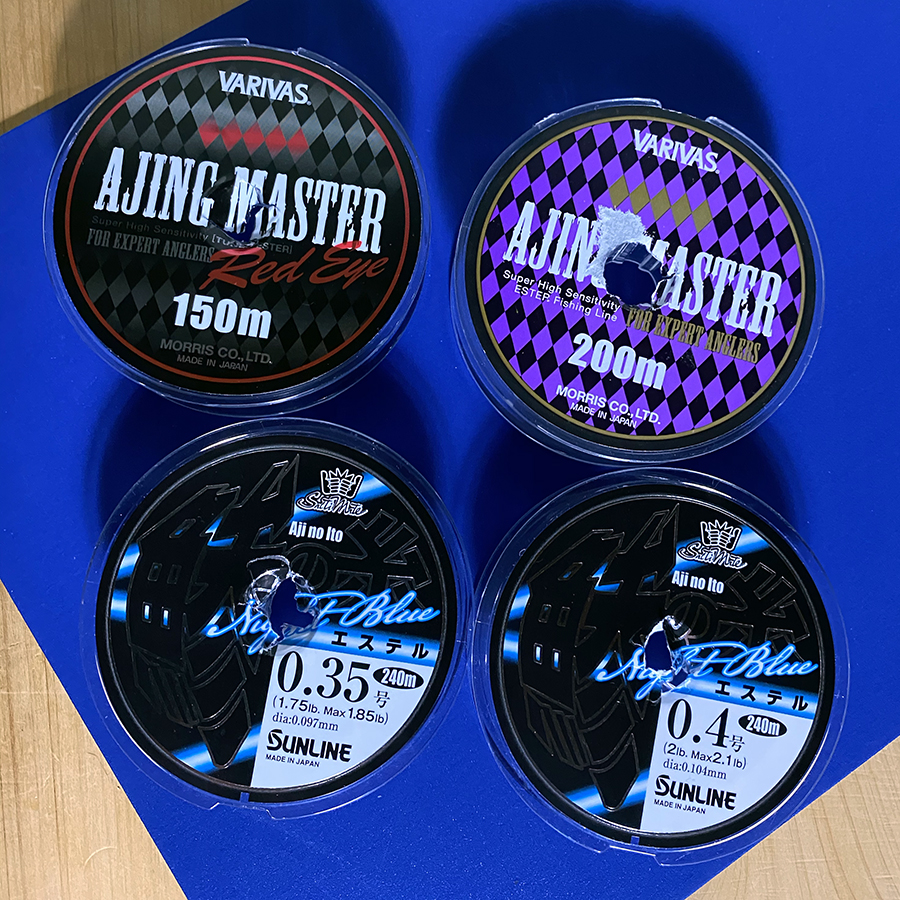
Line-size note: the Japanese text writes 3, 4, 5, 6 and 3.5 gō. These appear to mean #0.3, #0.4, #0.5, #0.6 and #0.35, consistent with the photograph and the manufacturers’ ranges. Those decimal values are used below. This is an editorial interpretation; the original wording is preserved in the source record. See SUNLINE’s 2018 Night Blue introduction and VARIVAS’s Red Eye specifications.
The setting here is a fishing spot with strong current. #0.3 ester line breaks rather easily, does it not? Of course, I suspect that is because I am not very good at using it.
My wife and I both fall into the “#0.3 is a little…” camp. It has broken at crucial moments several times. I should admit that I am not particularly diligent about line maintenance. A slightly embarrassed admission.
In any case, I cannot feel comfortable when a big aji turns up. So our usual choice is #0.4.
Ajing Master and Red Eye
We began with Ajing Master. The #0.3 kept breaking, so we changed to #0.4. That settled things for the time being, and we switched all our setups to it.
Then the same manufacturer brought out a highly sensitive line called Red Eye. Naturally, I tried it.
It has a taut feel, and the sensitivity seems excellent. Very nice indeed. Bites come through remarkably clearly. In digital-audio terms, it feels like going from 16-bit to 24-bit.
The whole sequence feels clearer: the hook-up, the fish’s movements immediately afterwards, and the fight as I bring it in.
The rod makes a difference
At first, I thought it might be useful for increasing sensitivity on a softer rod, so I put it on the 65TZ.
My wife’s response: “Something feels different. There is a slight sense that it is not quite right. I am going back to the old line.”
So my first idea did not work out in practice.
Next, I tried it on the Advancement 610. Now this was good. Very good. Wonderful, in fact—enough to make me want to put up with not being able to see the line at night.
It turned out to be a crisp rod that made me appreciate this line. But individual rods differ, so please take this as one experience to refer to, rather than a settled conclusion.
Finding #0.35 Night Blue
The next line I tried was Aji no Ito Ester Night Blue. This one is rather good too.
Because we fish in strong current, I skipped #0.3 and started with #0.4. I also tried #0.5: thick, but still usable. For good measure, I even tried #0.6, although that felt a little removed from ajing.
Then I discovered #0.35 in the Night Blue range.
That made me happy. “Yes! This might be it!” This manufacturer understands. It reaches exactly the spot that needs scratching.
I tried it, and it has been working well. No trouble so far. My wife is using it with the Blue Current JH Special 65/TZ.
These are the author’s experiences recorded in April 2020. The audio comparison describes a subjective impression, rather than a measured change in sensitivity. Related: handling two more ajing rods in Yamaga.
Read this article on Passionable Fishing (日本語) ↗